Residential Communities
Golf Carts for Communities
Explore golf carts for residential communities, gated estates and retirement properties. Configuration advice, vehicle options and factory support for your project.
Discuss Your Application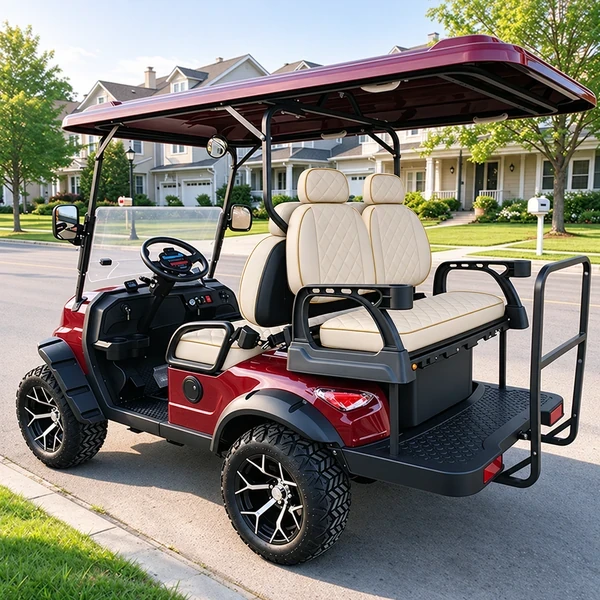

 EN
Explore golf carts for residential communities, gated estates and retirement properties. Configuration advice, vehicle options and factory support for your project.
Discuss Your ApplicationResidents & Property Teams
D-Series passenger layouts provide a starting point for household journeys and property-managed resident shuttles between homes, clubhouses and shared amenities. Plan patrols and grounds work separately around their tools and loading needs. Define the ownership model, approved routes and charging arrangements before choosing a fleet size.
List regular passengers, shopping or belongings, parking and home charging. Match seating and storage to the actual household and its journeys.
Identify peak waiting groups, regular stops, boarding needs and dispatch responsibility. Review the complete return cycle and usable passenger places.
Separate inspections, patrols and grounds work from resident transport. Specify tools, secure storage or an approved cargo area for the assigned task.
Ownership & Configuration
A development may offer both ownership models. Households choose around their own journeys; property teams need a repeatable shared service. Use the linked D-Series selector to compare the layouts below, including seat direction, boarding and the places available after allocating the driver and belongings.
Discuss D-Series 2+2 for two forward-facing and two rear-facing places, or four forward-facing seats for passengers facing the same direction. Match the arrangement to household members, belongings, boarding access and parking. The owner chooses trip times and takes responsibility for the agreed home-charging routine and local service arrangement.
Compare four forward-facing seats with the three-row, six-forward-facing D-Series for property-managed resident trips. A 4+2 alternative has a rear-facing row and needs its own boarding review. Check the selected vehicle at gates, turns and stops, and allow for the driver when planning resident places. Property operations coordinate dispatch, charging and inspections, using actual resident places and the full route cycle to size the fleet, with a separate maintenance reserve.
For belongings, discuss front storage or a rear trunk that fits the selected layout. Review a rear box against rear seats, boarding access and other fittings. Where an approved folding rear seat is offered, choose passenger use or cargo mode for that space; the folded area cannot carry seated passengers at the same time. Agree mounting, dimensions and load limits for the chosen arrangement, counting people and belongings together.
Route & Handover Planning
Combine the vehicle brief with the property’s operating rules. Household ownership and shared transport need different demand assumptions, but both need a clear route, charging process and local support contact.
Mark paths, crossings, pedestrian areas, gates, turns and charging locations. Identify which journeys require a separate vehicle category or operating-permission review.
Record passengers, boarding and restraint needs with the property team. Assess any specific access requirement against the proposed vehicle configuration.
For shared vehicles, count peak passengers and the complete cycle between departures. Account separately for charging, inspections, maintenance and demand variability.
Agree property-set driver rules, daily checks, key control and battery care. Define how owners or staff report faults and obtain parts or repairs.
Useful Answers
A private-property specification does not establish road-use eligibility. Identify the exact vehicle category and obtain the relevant documentation and operating permissions for every planned public-road segment or crossing.
Review the intended users, boarding arrangement, seating and restraints. A standard open passenger cart should not be assumed to satisfy every age-related or accessibility requirement.
Layout, battery and charger, storage, equipment, branding, quantity and delivery scope affect the proposal. Include the ownership model, route, charging locations, handover plan and local aftercare responsibilities when comparing offers.

Connect with Weiside
A Clear Conversation About Your Next Vehicle.
Let's Talk
Tell us what you're interested in and how we can help.
Selected References