
EN

Explore Weiside

Find Your Next Vehicle.

Industrial Sites & Logistics

Electric Utility Carts for Industrial Sites

Explore electric utility vehicles for industrial sites, warehouses and campus logistics. Configuration advice, vehicle options and factory support for your project.

Discuss Your Application
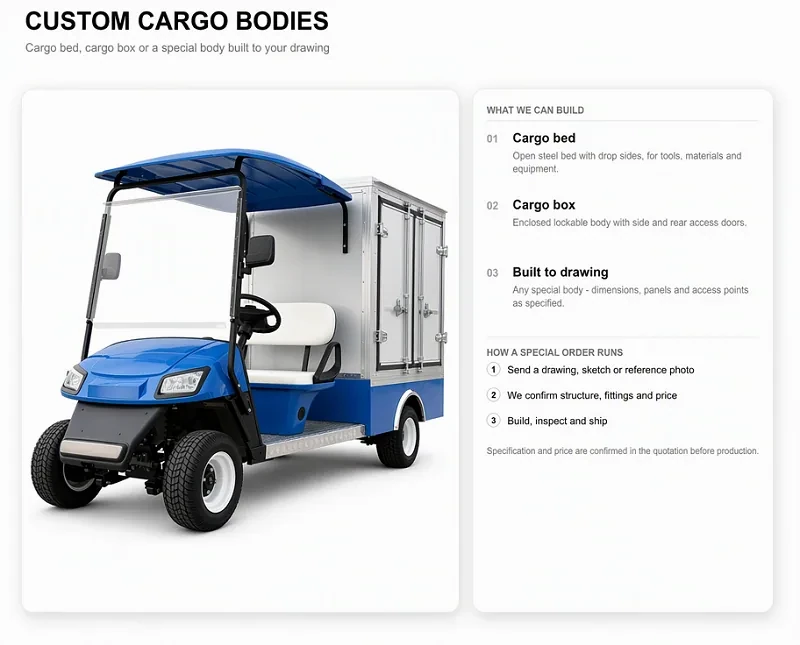
Supplier-provided A-Series enclosed cargo-body configuration reference

A-series enclosed cargo customization.

Industrial Sites & Logistics

Start with the Load and the Working Route.

Weiside reviews open-bed and enclosed-body configurations for maintenance rounds, warehouse transfers and site support. Match the body to the goods and handling method, then assess the complete vehicle rating and repeated working route. The body layout and loaded acceptance checks are agreed for the proposed build.

Supplier-provided A-Series enclosed cargo-body configuration reference

Maintenance Rounds

List tools, consumables and spare parts. Define storage, securing points and loading access at each stop, including where the vehicle shares space with pedestrians.

Building-to-Building Transfers

Record the largest item, total load and transfers per shift. Include loading heights, door openings and the equipment used to move goods at both ends.

Staff & Inspection Trips

Specify passenger places and inspection equipment separately from cargo duties. Include authorized routes, stopping areas and any visibility equipment required by the site’s operating plan.

Configuration Selection

Compare the Complete Working Build.

Choose the handling arrangement first, then review the complete vehicle rating, body weight and load distribution together. Request a technical sheet for the exact proposed cargo configuration.

Open Cargo Bed

Discuss a D-Series cargo layout where direct top or side access suits tools, parts and repeated transfers. Review usable bed dimensions, securing provisions and loading height for the goods being handled. Approve payload for the complete vehicle, with the fitted body and occupants accounted for.

Enclosed Cargo Body

The A-Series enclosed rear body illustrated above is a starting point for contained supplies and door-access discussions. Review internal space, openings and body weight with the load and occupants. Agree the required protection and security features for the proposed build rather than inferring them from an enclosure.

Shift & Route Fit

Review loaded stops, slopes, turns and surfaces alongside battery and charger limits. Use the full task cycle, charging window and maintenance coverage to estimate the fleet requirement.

Prepare the Project

Bring a Load List and a Route Survey.

Give purchasing, operations and the service team the same load and route information. List any equipment still to be confirmed while the proposed build is reviewed.

  1. 01

    Measure the Task

    Record item dimensions, the heaviest normal load, occupants and securing needs. Add drawings or photographs of the loading interface and any proposed racks or body fittings.

  2. 02

    Survey the Site

    Include narrow turns, gates, gradients, crossings, surface changes and pedestrian interactions. Identify any public-road segments separately from controlled-site routes.

  3. 03

    Plan the Shift

    State transfers per shift, task-cycle time, charging access and available downtime. Identify the people responsible for inspections, charging and routine maintenance.

  4. 04

    Agree the Review

    Request the exact configuration sheet and cargo drawing. Define representative loaded acceptance checks, handover records, critical parts and local repair responsibilities before purchase.

Useful Answers

Before We Talk.

What payload should we use for planning?

Request the approved rating for the exact vehicle, fitted body and occupant arrangement. Cargo volume, motor power and passenger-cart figures are not substitutes for that complete specification.

Can the vehicle tow a trailer?

Submit the trailer, hitch loads, route and gradients for review. Use only a configuration with explicitly approved towing and braking limits; a fitted tow hook does not establish towing capacity.

Can it operate on public roads?

Identify the destination and every public-road segment in the brief. Vehicle category, documentation and applicable local operating requirements need confirmation for the proposed build and route.

What makes quotations comparable?

Compare the same documented load, body drawing, battery and charger, equipment, quantity, delivery scope and support responsibilities. Include the agreed loaded acceptance conditions in each proposal.

Weiside electric vehicle at a golf course — design illustration

Connect with Weiside

A Clear Conversation About Your Next Vehicle.

In-Person Factory VisitLive Video Tour

Let's Talk

Plan Your Industrial Utility Fleet.

Tell us what you're interested in and how we can help.

Your details, page URL and IP address are used to handle your inquiry. See our Privacy Policy.

Let's Talk

Get Your Custom Quote.

Tell us what you're interested in and how we can help.

Your details, page URL and IP address are used to handle your inquiry. See our Privacy Policy.