Golf Courses
Electric Golf Carts for Golf Courses
Explore electric golf carts for golf courses and country clubs. Configuration advice, vehicle options and factory support for your project.
Discuss Your Application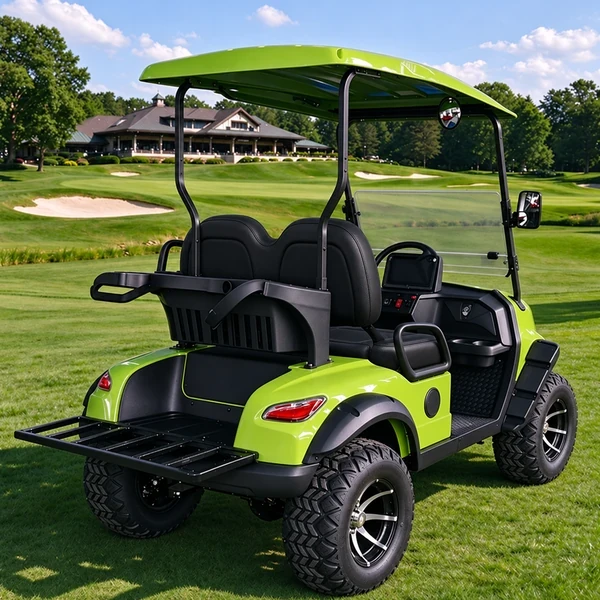

 EN
Explore electric golf carts for golf courses and country clubs. Configuration advice, vehicle options and factory support for your project.
Discuss Your ApplicationCourse Operations
D-Series offers a two-seat starting point for player rounds and passenger layouts for clubhouse connections. Plan marshal and course-service duties separately. Record players and bags, departure waves, round duration and the paths permitted by course management. A loaded round, including the steepest climb and wet-weather restrictions, gives a more useful brief than a seat count or a carts-per-hole assumption.
Specify player places, secured bag positions, canopy coverage and the accessories used during a round. Seat count does not establish usable bag capacity.
Map practice-range, parking and visitor transfers. Review passenger boarding, path width and stopping space independently from the player fleet.
List radios, drinks, tools or supplies and their working shifts. Allocate a suitable passenger or approved cargo configuration, and account for these duties when planning player-cart availability.
Configuration Choices
A dedicated player fleet follows repeatable rounds; a mixed-use fleet handles changing club duties through controlled dispatch. Use the linked D-Series layout selector to compare the arrangements below, with charging and support planned for each duty.
The D-Series two-seat layout is a starting point for two players with secured golf bags. Discuss a matched bag rack to hold the bags and a bag cover for weather protection, a ball washer for cleaning during the round, sand bottles for divot-repair material and a cooler for drinks. Review these options for the selected build, including mounts, quantities and space around the bags. Include the chosen package and course-approved tires in the loaded route test.
For clubhouse, parking and practice-area connections, compare the D-Series 2+2 layout, with two rear-facing places, against four forward-facing seats. Allow for the driver when planning guest places. Review boarding access and secured bag space separately; extra seats do not establish golf-bag capacity.
Request the quoted battery, usable capacity, charger and care instructions. Compare vehicle price, charging installation, initial spares, preventive service and expected downtime over your own planned replacement period.
Fleet Planning
Base fleet size on simultaneous use. Allow for player demand, service duties and vehicles unavailable for charging or maintenance, then evaluate a representative sample before approving the specification.
Use tee-time spacing, cart take-up and the approved players per vehicle to estimate carts in use when the next departure wave arrives.
Include staging, bag loading, the round, cleaning, inspection and the selected battery’s charging window before the next dispatch.
Allow separately for charging, maintenance and tournament-day demand. Do not assume every cart remains available for every tee time.
Record loaded handling, braking, route completion and charging observations. Keep the approved configuration, parts list and service responsibilities with the order.
Useful Answers
Tires are one part of the course-care plan. Ground conditions, traffic concentration and routing restrictions also matter. Agree the tire package and permitted paths with course management.
Standardizing the selected battery and charger can simplify service, provided the usable energy and charging window fit each assigned duty. Confirm the actual offered package before applying it across the fleet.
Send the tee-time pattern, player and bag allocation, route distance and gradients, charging windows, quantity and destination. Include sample-test priorities, golf accessories and target delivery timing.

Connect with Weiside
A Clear Conversation About Your Next Vehicle.
Let's Talk
Tell us what you're interested in and how we can help.
Selected References